

Buy Custom Embroidered Shirts Online: 2026 Buying Guide
Table of Contents
- Why Buy Custom Embroidered Shirts Online in 2026
- Custom Embroidered Shirts No Minimum: What to Expect
- Custom Embroidery Shirt Cost: Setup Fees, Thread, and Price Per Item
- Best Shirts for Embroidery: Garment Types That Hold Stitches
- Preparing Artwork and Choosing Design Placement
- Turnaround Times, Proofs, and Delivery Reliability
- How to Wash Embroidered Shirts So Stitching Lasts
- Conclusion
- Frequently Asked Questions
Last Updated: October 19, 2026
Why Buy Custom Embroidered Shirts Online in 2026
Ordering custom embroidered shirts online in 2026 means you can pick a garment, upload artwork, preview a digital proof, and have a finished piece shipped to your door without ever visiting a shop. The appeal is simple: embroidery adds texture and dimension that printing cannot match, and it holds up through repeated washing.
At Christina Lorraine's, we make every embroidered piece to order, so each shirt reflects your colors, your name, and your occasion. That matters whether you need team spirit wear, a teacher gift, or a shirt for a family celebration.
The biggest shift this year is how easy the ordering process has become. You no longer need to describe a design over the phone. That transparency is worth demanding, because a proof is your last chance to catch a misspelled name or a logo in the wrong spot. Below, we break down cost, garment choice, artwork prep, and care so you can order with confidence.
Custom Embroidered Shirts No Minimum: What to Expect
A no minimum order means you can buy a single custom embroidered shirt instead of committing to a bulk run. That fits gift-givers, small teams, and anyone testing a design before scaling up.
Custom Embroidery Shirt Cost: Setup Fees, Thread, and Price Per Item
Custom embroidery shirt cost breaks into five parts: the garment, the digitizing fee, the stitching, any personalization add-ons, and shipping. Understanding each piece is the only way to compare quotes fairly, because two shops can list the same $25.00 shirt and land at very different totals.
| Cost Component | What It Covers | When You Pay It | Typical Range |
|---|---|---|---|
| Garment | The blank tee, tank, polo, or sweatshirt | Every order | $15.00-$45.00 at Christina Lorraine's |
| Digitizing fee | Converting your logo or text into a stitch file | First order only, per design | Ask before you commit |
| Stitching | Thread, backing, and machine time | Every order | Baked into the listed item price |
| Personalization | Names, dates, or thread color changes | Per item | Confirm per name |
| Shipping | Carrier delivery to your address | Per order | Varies by speed and destination |
At Christina Lorraine's, our embroidered pieces start at $15.00 for a seasonal tee and run to $45.00 for a personalized appliqué crewneck. For example, the Personalized Teacher Tee is $25.00, and the Football Mom Custom Personalized Applique Crewneck Sweatshirt is $45.00. A simpler design keeps stitching cost down; dense logos and 3D puff embroidery add machine time and raise the price.


How to build a real total-cost estimate
Use this four-step method before you request a quote from any shop:
- Pick the garment and quantity. Multiply the listed item price by the number of shirts. A single $25.00 tee is $25.00; ten of the same tee is $250.00 before setup.
- Add the digitizing fee once per design. This is a one-time charge to turn your artwork into a stitch file.
- Add personalization per item. Names, dates, and thread color changes are usually priced per shirt, so a team of twelve with individual names pays that add-on twelve times.
- Add shipping and any rush fee. Standard shipping is quoted at checkout; rush production and expedited delivery are separate line items. Ask for both numbers in writing.
What actually moves the price up or down
- Stitch count. More stitches mean more machine time. A small left-chest logo might run a few thousand stitches; a large back design can run into the tens of thousands.
- Thread colors. Each color change adds machine time. Limiting a design to two or three colors usually lowers the stitch cost.
- Garment weight and fabric. Heavier cotton and fleece cost more as blanks but hold dense designs better, so you are paying for durability, not just material.
- Turnaround. Rush production is a real cost. If a deadline is fixed, budget for it rather than hoping standard production clears in time.
If you plan to reorder, the smart move is to personalize one shirt first, approve the proof, and then commit to quantity with the same stitch file.
Best Shirts for Embroidery: Garment Types That Hold Stitches
The best shirts for embroidery are medium-weight cotton or cotton-blend garments with a tight, stable weave. A stable fabric keeps stitches from puckering and holds dimensional embroidery without sagging. Thin, stretchy fabric is the enemy of clean stitching.
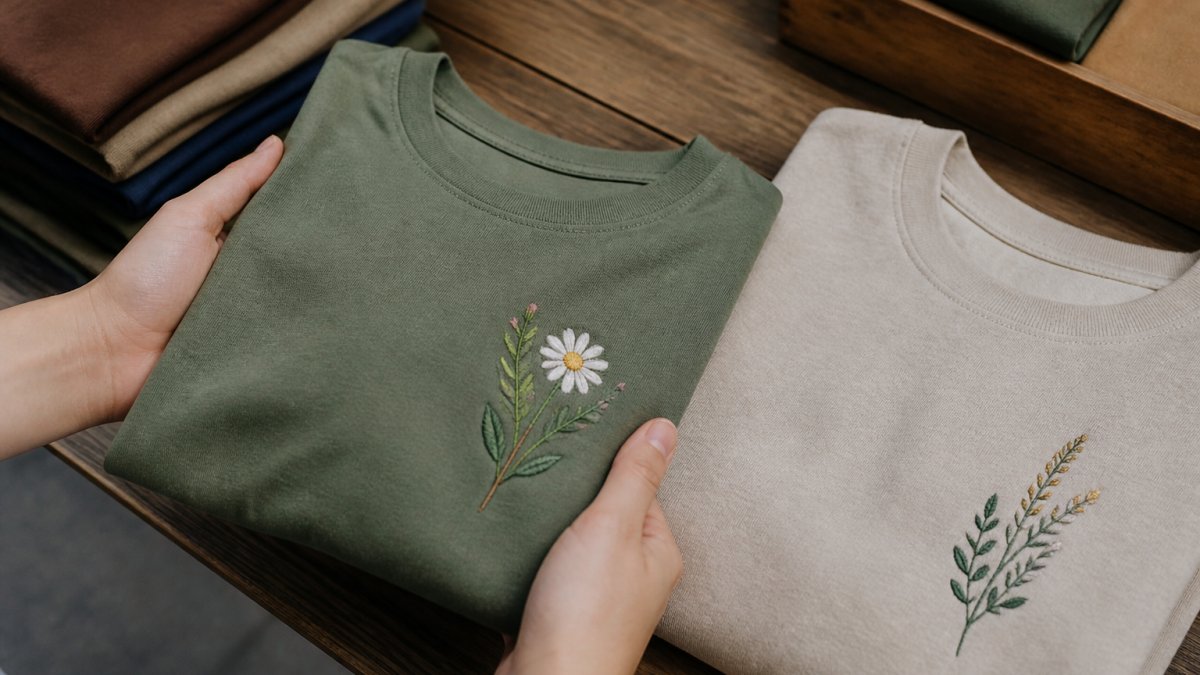
Here is how the main garment types compare:
- T-shirts: The workhorse for logo embroidery and personalized designs. Our School Spirit Embroidered Football Tee at $25.00 uses a two-color gradient sew-out that holds crisp on a stable tee.
- Polos and dress shirts: Structured collars frame a chest logo well and suit company apparel and uniforms.
- Tanks: Great for warm-weather personalization, like our Personalized MAMA Sequin Appliqué Tank at $35.00.
- Sweatshirts and crewnecks: Heavier fabric handles larger, denser designs with ease.
Check the size range before ordering, especially for youth sizes or an extra-small. A garment that fits well makes the embroidery look better.

Preparing Artwork and Choosing Design Placement
Clean artwork is the difference between sharp embroidery and a muddy result. Embroidery redraws your design in thread, so simple shapes, bold text, and limited colors translate best. Small text and fine gradients get lost in stitching.
Follow these steps to prepare your artwork:
- Confirm your spelling before the proof stage. We will not be responsible for incorrect spelling submitted on your behalf.
Design placement matters just as much. The left chest is the standard for logos, while a full front works for bold statements and a sleeve suits a small name or date. Ask for a digital proof and check placement, scale, and thread color before production.
Personalized MAMA Sequin Appliqué Tank, Tee Or Sweatshirt →
Turnaround Times, Proofs, and Delivery Reliability
Turnaround is the part of an online embroidery order buyers underestimate most. Made-to-order items need production time before they ship, and that window is separate from shipping time. Treat them as two clocks: production starts after you approve the proof, and shipping starts after production ends.
The two-clock model
- Proof clock. After you upload artwork, the shop digitizes it and sends a digital proof. Review time is on you, the sooner you approve, the sooner production starts. A revision restarts this clock.
- Production clock. Once approved, the garment is stitched, finished, and packed. Simple single-color designs move faster than dense multi-color logos or appliqué work.
- Shipping clock. The carrier takes over. Standard and expedited options have different transit times, and the estimate you see at checkout is transit time only, not production.
A simple single-color left-chest logo is the fastest path through both clocks. A dense multi-color back design, 3D puff, or appliqué adds machine time and usually adds days. If your order includes individual names, each name is a separate sew-out and adds to the production window.
How to plan against a hard deadline
- Work backward from the event date. Subtract shipping transit time, then subtract the production window, then subtract a buffer for proof revisions. The date you land on is your order-by date.
- Order at least two to three weeks before a hard deadline when you can. Made-to-order embroidery is not instant, and a buffer absorbs proof revisions or carrier delays.
- Ask for the production window in writing. A reputable shop will tell you the current production estimate before you pay, not after.
- Confirm whether rush production is available and what it costs. Rush is a separate line item; budget for it if the deadline is fixed.
- Ship to an address where someone can receive the package. A missed delivery can add days you did not plan for.
Why the proof is your delivery insurance
Proofs protect you here. A reputable shop sends a digital proof and waits for your approval before stitching. That step prevents most delivery disappointments, because the most common cause of a missed deadline is a proof that sat unapproved or a design that needed a revision late in the process. Approve only after checking spelling, placement, and thread colors, the proof is your last clean look at the order.
How to Wash Embroidered Shirts So Stitching Lasts
Turn embroidered shirts inside out and wash them in cold water on a gentle cycle to protect the thread. Skip the dryer's high heat, which can shrink fabric and dull thread over time. Air drying flat keeps stitching crisp.
A simple care routine:
- Wash inside out in cold water
- Use a mild detergent and skip bleach
- Avoid fabric softener, which can coat thread
- Air dry or tumble on low
- Iron on the reverse side, never directly on the embroidery
Thread quality shows over time. Premium thread and durable stitching resist fraying and color fade, which is why a well-made embroidered shirt outlasts a printed one that peels after a few washes.
Conclusion
Choosing the right custom embroidered shirts comes down to three decisions: the garment, the design, and the timeline. Get those right and you end up with a piece that looks sharp and lasts for years.
At Christina Lorraine's, we make every item to order with your colors, names, and occasion in mind. Our handmade custom gifts, personalized apparel, and themed collections for Awareness, Christmas, Fall Favorites, and Game Day give you a starting point for any celebration. Browse our embroidered tees and sweatshirts, pick your thread colors, and we will stitch something made just for you.
Frequently Asked Questions
Can I order a single custom embroidered shirt?
Yes. Many made-to-order shops produce one-off pieces rather than requiring bulk quantities. A single custom embroidered shirt typically costs more per item than a bulk order because setup work is spread across fewer units, but the per-item price stays transparent. If you only need one gift or one spirit-wear shirt, a no-minimum order is the simplest route.
What file format do I need for custom shirt embroidery?
Embroidery requires a digitized file that maps thread paths, so a shop will convert your artwork into a stitch file before production. Clean, high-contrast images with clear edges digitize best. Avoid screenshots or blurry photos, which force guesswork on lettering and small details.
How much does it cost to get a shirt embroidered?
Cost depends on the garment and stitch count. At Christina Lorraine's, embroidered tees start at $15 to $25, crewneck sweatshirts run $35 to $45, and sequin appliqué designs sit around $35. Ask for an itemized quote that separates garment cost and any personalization charges so nothing surprises you at checkout.
Is embroidery better than printing for custom shirts?
Embroidery outlasts most prints because thread is stitched into the fabric rather than layered on top. Printed graphics can crack or peel after repeated washing, while embroidered designs hold their shape for years. Embroidery also adds visible texture and a dimensional look that flat printing cannot match. The trade-off is that embroidery suits bold logos, names, and simple shapes better than photographic detail. For team apparel, workwear, and gifts meant to last, embroidery is usually the sturdier choice.
How do I choose a shirt for embroidery?
Pick a fabric with enough weight to support stitching without puckering. Cotton and cotton-blend tees, polos, and crewneck sweatshirts handle embroidery well, and garment-dyed options like Comfort Colors feel soft from the first wear. Avoid thin, stretchy fabrics that distort under dense designs. Match the garment to the use: tees for game days and casual wear, polos for workwear, sweatshirts for cooler months. Check the size range before ordering so youth and adult fits both work for your group.


